September 26, 2025
Fortifying the Modern Web Application
A practical, layered five-layer defense strategy for the modern web application, moving from the outside in to build a resilient and secure system.
Today's web application is not a monolithic fortress; it's a sprawling, dynamic collection of microservices, APIs, and cloud infrastructure. It is the vibrant digital agora of modern business, the primary interface for our customers, and, without question, the principal target for our adversaries.
For too long, we've clung to an outdated security model. We built a strong perimeter firewall and assumed anything inside was safe. This is like building a mighty castle wall and leaving all the inner doors unlocked. In today's landscape of sophisticated threats and porous network boundaries, this approach is not just flawed, it's negligent.
Security must be pervasive, deeply integrated, and relentlessly automated. To achieve this, we need a new blueprint. This article presents a practical, five-layer defense strategy for the modern web application. We will move from the outside in, building a resilient system where each layer anticipates the failure of the last and reinforces the others.
Layer 1: The Edge - Your Automated Gatekeeper
This is your first line of defense, a vigilant gatekeeper that filters malicious traffic before it ever gets a chance to touch your application's infrastructure.
Core Technology: The Web Application Firewall (WAF)
A WAF acts as a reverse proxy, inspecting all incoming HTTP and HTTPS traffic for common attack patterns like SQL injection, cross-site scripting (XSS), and command injection. But the modern, cloud-native WAF (think AWS WAF, Azure Application Gateway WAF, or Cloudflare) has evolved far beyond simple signature matching. Its capabilities are essential:
- Managed Rulesets: These are automatically updated by security experts to protect against the latest zero-day vulnerabilities and emerging threats, saving your team from the endless cycle of rule-tuning.
- Bot Detection & Rate Limiting: A modern WAF can distinguish between human users and automated bots. This allows it to intelligently throttle or block web scrapers, credential stuffing attacks, and application-layer Denial-of-Service (DDoS) attempts that would otherwise exhaust your application's resources.
- API Security: With applications being driven by APIs, the WAF provides specific, crucial protections for REST and GraphQL endpoints, enforcing schema validation and preventing abuse.
This layer works in concert with broader DDoS protection services to absorb massive network-layer attacks, ensuring your application remains available even under direct assault.
Here's a simplified view of the Edge Layer:
Layer 2: The Network - A Foundation of Micro-segmentation
Assume an attacker will eventually bypass the Edge. Your internal network architecture must be designed with a Zero Trust mindset, preventing an intruder from moving laterally to access your most sensitive systems.
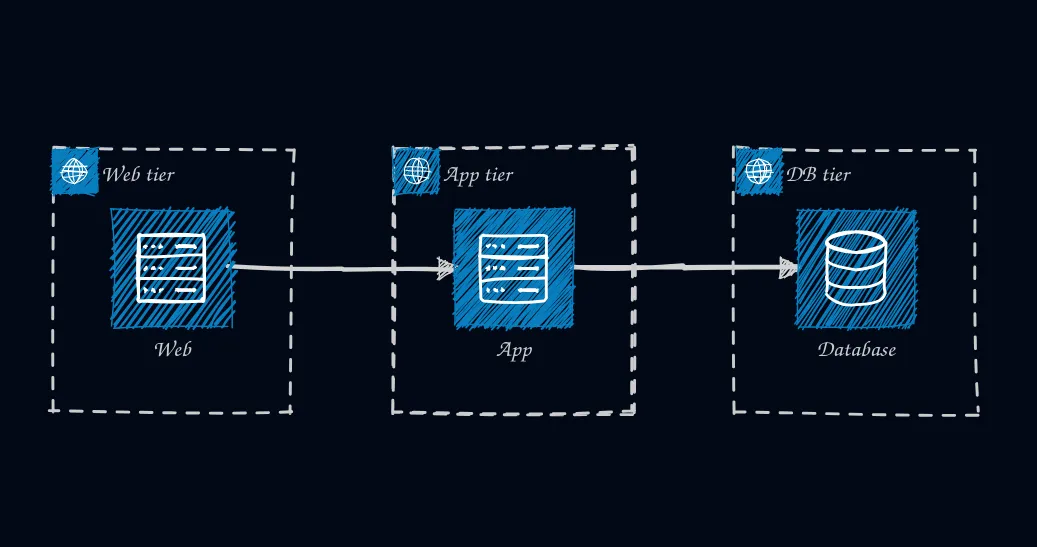
The classic 3-tier model (Web, App, Data) is a good starting concept, but we must evolve it. The modern approach is micro-segmentation.
Architectural Pattern: Isolate Everything
Instead of broad network zones, each individual component-every web server, API service, database, and cache-gets its own minimal network security policy. It is only allowed to talk to the specific components it absolutely needs to, and nothing else.
Example:
- An AWS Security Group for your web servers only allows inbound traffic on port 443 from your WAF and load balancer.
- Critically, it only allows outbound traffic to the Application Server's Security Group on port 8080.
- The Application Server's Security Group, in turn, only allows inbound traffic from the web servers' group and outbound traffic to the database's Security Group on port 3306.
- The Database Security Group allows no outbound internet access at all.
With this configuration, a breach of a web server is contained. The attacker cannot pivot directly to your database; their path is blocked by a well-defined architectural boundary.
Here's a visual representation of micro-segmentation in a cloud environment:
Layer 3: The Pipeline - Building Security In (DevSecOps)
The most efficient and cost-effective way to fix vulnerabilities is to prevent them from being deployed in the first place. This is the "shift left" philosophy, where we embed automated security checks directly into the CI/CD pipeline.
Key Pipeline Gates:
- SAST (Static Application Security Testing): As developers commit code, SAST tools like SonarQube or Snyk Code automatically scan the source code itself, finding security flaws, bad practices, and potential injection vulnerabilities before they ever become part of a build.
- SCA (Software Composition Analysis): This is non-negotiable. Modern applications are built on open-source libraries. SCA tools like OWASP Dependency-Check or Trivy scan these dependencies for known vulnerabilities (CVEs), preventing a crisis like the Log4j incident of years past.
- IaC (Infrastructure as Code) Scanning: Your infrastructure is defined in code via tools like Terraform or Bicep. Scanners like
tfsecorcheckovanalyze this code to find security misconfigurations-such as a publicly accessible S3 bucket or an overly permissive firewall rule-before your infrastructure is ever provisioned. - Container Scanning: Before a container image is pushed to your registry (e.g., Amazon ECR, Azure ACR), an automated scan checks for vulnerabilities in the base operating system and its packages, ensuring you don't deploy a known weakness.
Here's how a secure CI/CD pipeline integrates these tools:
Layer 4: The Code - The Developer's Security Mandate
Even with a perfect pipeline, secure coding practices are the bedrock of application security. The OWASP Top 10 provides the essential curriculum for what every developer must know and practice.
Focus on the Fundamentals:
- A01: Broken Access Control: This remains the most common critical vulnerability.
- Problem: An API endpoint like
/api/users/{id}/profilechecks if a user is authenticated but fails to check if the logged-in user is the same as the{id}in the URL, allowing any user to view any other user's profile. - Solution: Implement and enforce centralized, non-bypassable authorization checks on every single request, based on the user's validated session claims.
- Problem: An API endpoint like
- A03: Injection:
- Problem: A developer concatenates user-provided input directly into a database query string.
- Solution: Never, ever trust user input. Exclusively use parameterized queries (also known as prepared statements). This fundamental technique separates the query logic from the user data, making SQL injection structurally impossible.
- A02: Cryptographic Failures:
- Problem: A developer stores sensitive data in plain text or uses outdated, weak encryption algorithms for data at rest.
- Solution: Use modern, strong, salted hashing algorithms like Argon2 for passwords. Encrypt all sensitive data at rest and mandate TLS 1.2+ for all data in transit. Ensure key management follows best practices (e.g., using cloud Key Management Services).
Layer 5: The Runtime - Active Defense and Observability
Protection doesn't stop at deployment. You must actively monitor and defend your application while it is running.
Key Technologies:
- Malware Scanning: This is essential for any application that allows file uploads. All user-submitted files must be scanned in an isolated environment before being stored or made accessible to other users.
- RASP (Runtime Application Self-Protection): This is a more advanced, context-aware control. RASP instruments the application from within, like a security agent running inside the code itself. It can detect and block attacks like injection even if they bypass the WAF, because it sees exactly how the malicious input is affecting the application's internal execution flow.
- Comprehensive Logging & SIEM: You cannot defend what you cannot see. Every layer-your WAF, servers, containers, and application code-must produce structured, meaningful logs. These logs must be aggregated into a central SIEM (Security Information and Event Management) platform, like Microsoft Sentinel or Splunk. There, automated correlation rules can detect suspicious patterns across your entire stack, turning disparate events into a single, actionable security alert.
This final layer provides the crucial feedback loop:
Conclusion: Security is a System, Not a Product
True application security is not about buying a single magic box or tool. It is about the systemic interplay of multiple, reinforcing layers of defense: the Edge, the Network, the Pipeline, the Code, and the Runtime.
But even this technology is only half the battle. A successful security program requires a culture of collaboration and shared ownership, where developers, operations, and security teams work together, not as adversaries, but as partners in a common mission.
Stop treating security as a feature or a final gate to be checked off. Architect it into the very foundation of your systems. A secure application is not an accident; it is the deliberate, inevitable result of excellent engineering.